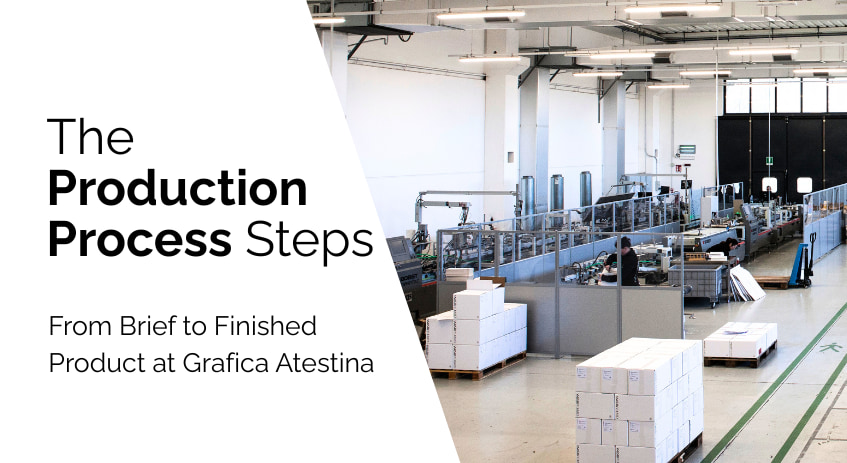

How long does it actually take to create custom packaging? The answer mostly depends on one thing: how clear the starting point is. The production process is divided into two macro-phases: the design and approval phase, and the production phase. Total lead times largely depend on the first phase—the one that happens long before the printing presses even start running.
Phase 1: Consulting, Design, and Artwork Approval
Technical consulting and brief analysis: It all starts here. Before any physical work begins, it's essential to understand exactly what needs to be achieved: product type, format, materials, logistical constraints, communication goals, and budget. Every decision made at this stage impacts all subsequent phases. Choosing an unsuitable material or failing to define dimensions accurately means slowing down the entire production cycle—sometimes by weeks—due to revisions and additional samples.
Structural design and dieline development: Once the brief is finalized, the dieline is created: the cut-and-crease template that will give shape to the packaging. Every millimeter counts for folds, interlocking tabs, and closures. If doubts arise or information is missing, you risk starting all over again. Having clear ideas from the start avoids these wasted steps.
Unprinted sample and functional testing: The first physical prototype is the blank sample—the packaging in its final shape without graphics. It serves to verify that dimensions, closures, and functionality are correct. Many projects stall here because it's only at this stage that people realize the format isn't practical or the product doesn't fit as expected.
Prepress and color proof: The prepress department checks that artwork files comply with technical specifications: low-resolution images, PDFs without bleeds, overprinting issues, or unmanaged color profiles require corrective actions that add days to the cycle. A certified color proof is then produced to accurately simulate the final result.
Printed sample and final approval: The fully printed prototype is the final check: the finished packaging, printed and die-cut exactly as it will appear in the final production run. This phase can also drag on if internal decision-making processes aren't planned ahead. When approval involves marketing, management, and external suppliers without clear coordination, delivery dates get pushed back quickly.
Phase 2: Production Cycle — When Everything Is Approved, We Print
Once Phase 1 is complete and approved, the actual production phase begins right after the PRESS PROOF APPROVAL.
- Printing: The printing presses run the final quantity. If the files were correct, printing proceeds smoothly.
- Finishing/Embellishments: If special treatments are specified—such as lamination, UV coating, or hot foil stamping—they are applied during this stage.
- Die-cutting and folding-gluing: The printed sheet is die-cut according to the dieline layout, then folded and glued to form the finished packaging.
- Bindery: In the case of instruction sheets, brochures, or leaflets, the bindery stage handles folding, cutting, and assembly.
- Delivery: Once production is complete, the material is packed and shipped according to the chosen destination and transport method.
What Actually Slows Down a Project? Most delays occur in the first phase, not the second
- Incomplete brief: without precise information on product, materials, and constraints, every step requires clarification
- Non-compliant graphic files: low-resolution images, incorrect color management, and missing bleeds bring the process to a halt
- Unstructured approval cycles: when decisions pass through multiple stakeholders without a coordinator, feedback arrives in piecemeal fashion
- Late-stage design changes: requesting changes after a sample is approved means shifting the delivery date.
Knowing these factors in advance makes all the difference between a smooth project and one that drags on for months.
At Grafica Atestina, we believe in the value of getting off to a GOOD start, because quality comes from clarity. That’s why we invest time in initial consulting—not to complicate the process, but to make it more efficient.
Have a packaging project to bring to life? Contact us at info@graficaatestina.it and request a free consultation